Thursday, September 3, 2015

What My Daughter Learned in Preschool


We found a toad today!
Preschool has started again for my daughter; and although I love seeing her enthusiasm for going to school, her love of learning and exploring, seeing her friends, etc., there was one not-so-welcomed lesson she learned last year.  I spent the summer trying to undo it and will try to stay on top of it this year.  I don’t believe the lesson was taught by her teachers, but most likely by her classmates.  The lesson was in gender roles.  She came home convinced that boys do certain things and girls do others! 

I can overlook my daughter’s desire to wear dresses, a stereotypical “girl thing.”  After all, they are much easier to deal with while potty training.  I don’t mind her devotion to the Disney princesses; I adored them when I was little too.  Even her interest in the perfect pair of sandals or Mary Jane’s doesn’t bother me since little kids’ shoes are just so darn cute!  But when my daughter came home from school last year and said frogs are gross, I think my heart broke.

There were other issues too that my husband and I had to work on (and are still working on) with her about girls being able to do anything boys can do.  But saying bad things about frogs (and other animals) just because they are not something “girls take interest in,” hurt.  How can my daughter think that?!?  I have a love for almost all animals and have a great respect for those I don’t quite love.  And frogs are at the top of my list of animals I love!  How can they be gross to my daughter? 

After a few months over the summer without her outside influences, my daughter is back on the right track again to at least respecting all animals.  Her love for our dog and cats has blossomed over the summer.  Even our pet snake and macaw are high on her list of much loved animals (even though she is not old enough to handle either of them right now).  She also talks about spiders being friendly and mosquitoes only bite because they want to have babies.  Dragons still reign as her preferred imaginary animal, and her favorite color is blue, not pink.  She still wears dresses and wants to be a princess; but, her most requested shoes are sneakers (yes, they light up and are Disney princess shoes, but they are still sneakers)!

All humor aside, respect for animals is one of the most important lessons children need to learn.  It will be important throughout their lives, for both them and the animals.  Through my years of being a naturalist, I’ve met many people from a variety of backgrounds with great fears or dislikes of an assortment of animals.  I, myself, had a fear of spiders as a child and had nightmares every night after seeing just one spider during the day.  I lived on a farm with a large, old barn; so this happened quite often.  I’ve never been hurt by a spider, therefore my fears were unfounded and probably learned from someone else (or Little Miss Muffet).  Unfortunately, that happens all too often.  And my daughter saying that frogs are gross is definitely something she learned from someone else and not from firsthand experience.

Sure if my child had ever held a frog, it would probably pee on her.  But she hasn’t held one, so she hasn’t had that experience (yet!).  However, when she does hold one and it urinates on her, I hope someone is there to ask my daughter why she thinks the frog did that.  Animals exhibit behaviors for a reason.  It’s not gross.  The frog just doesn’t want to be harmed.  And who could blame it since children often don’t realize their own strength when holding a small animal.  Urinating is one of several defenses a frog may use.  And it usually works!  Most children will drop a frog immediately when the frog starts to pee in a child’s hands.  If I’m ever caught by a giant, I might do the same thing.  Who knows?  Does that make me gross or a survivor?  And there are a lot of interesting facts about frogs that can be taught in such a teachable moment.  Everything from their distinct vocalizations, lifecycle, how they are well adapted to their habitats, to their thin layer of skin that they can breathe through that makes them amazing animals. 

Children don’t have to love every animal in the world, but they should respect them.  The best way to do that is to learn more about animals.  If your child is afraid of or dislikes an animal, ask why.  Talk about your child’s feelings.  Take time to learn about the animal.  Observe the animal in the wild.  Talk to animal experts.  Read books.  All of these go a long way to help alleviate those feelings and build respect.  After all, my spider nightmares stopped long ago.  I find garden spiders and their beautiful webs interesting now.  And as a naturalist, I’ve cared for and handled many tarantulas.  Understanding spider behaviors has greatly helped foster my respect for them.  Now if I can just get through to the other children at my daughter’s preschool, maybe snails and puppy dog tails won’t be just for boys.


Please share your experiences if your child has a fear or dislike of any type of animal.  Maybe we can help ease that fear or dislike together.

After this post was written, I found a Southern toad (Anaxyrus terrestris) in our yard and introduced it to my daughter after school today.  She did not get peed on and now likes frogs!  Success!
Southern toad (Anaxyrus terrestris)
I love how she is being very gentle and cupping the toad instead of squeezing it.
Returning the toad back to its home.

Wednesday, July 1, 2015

Small Gardening Projects, Perfect for Small Hands!


Repotting Plants

Have you been putting off small gardening projects like repotting/relocating plants around your garden because they are “small” projects, and you’ll (probably) get around to doing them eventually?  Well, put them off no longer.  They are a perfect activity for your little preschooler this summer, and here are ten reasons why.

  1. Children love to play in dirt!  They are closer to the ground and are ready to make new discoveries with what they see and touch. It’s hands-on exploration at its best!
    Scooping Dirt
  2. At this age, children love to help!
  3. Gardening is educational for this age group.  You can talk about plants being living organisms.  They need food, water, sunlight, and space to grow and thrive.  Show the roots of a plant where it takes up nourishment (food and water) from the soil.  The green leaves soak up energy from the sun.  By gardening, you are making space for plants. 
  4. Gardening is a great introduction to some very important life lessons, such as patience, rewards of nurturing skills, responsibility, and even loss.
  5. Gardening can also help initiate environmental awareness through understanding the importance of plants as the primary producers in the web of life.
  6. Physically, gardening helps young children learn control when pouring dirt or water around a plant.
  7. Gardening can create a relaxing space to be enjoyed for years to come.  A garden can reduce stress and is a place to spend time outdoors.
  8. It’s easy to find (adorable) kid-sized gardening tools in any garden center where adult-sized tools can be found.  But, children don’t really need tools to play in the dirt (It’s fun either with or without tools)!
  9. Gardening gives young children pride in their new abilities to help and care for another living thing.
  10. Most importantly, it’s an activity you can do as a family!

So get out there and start gardening with your child!
Patting the Dirt


Watering the Newly Planted Plant


Friday, May 8, 2015

A Mother's Love


Two Juvenile Red-Shouldered Hawks in Nest
Last week, I was thinking about wild animal moms and which animal I wanted to focus on for Mother’s Day.  I decided to write about our local red-shouldered hawks (Buteo lineatus); because they decided to build a nest in our neighbor’s front yard a couple of months ago, with easy viewing from my daughter’s bedroom window.  I knew there was at least one baby in the nest since I had seen the parents feeding it.  So last Saturday morning, I spent some time outside with my camera and binoculars trying to get a glimpse of it.  That was not easy since the nest is probably 50 plus feet up a pine tree. Be that as it may, I did see them, and there were two juveniles!  Sadly, later that same day, I learned from my neighbor that one of the babies had fallen out of the nest.  As a mom, I was devastated!  How could a baby survive that fall?  And how would I explain it to my daughter?  Clearly, this was not a great subject for a Mother’s Day conversation.

Seeing two baby birds that morning was exhilarating for me.  My husband and I have lived in our house since long before our daughter was born, and we feel like we know at least one of these birds pretty well.  If you have a red-shouldered hawk where you live, you know it.  They are very vocal birds of prey repeating a loud “Kee-aah” scream that can be heard more than a mile away.  Our pair usually nested in our back woods where we would hear them on a regular basis.  Over the years, the parents often hunted for snakes and lizards in our yard.  They even regularly watched my husband as he mowed grass hoping an easy meal would be scared out into the open.  The hawks usually had one baby each summer that fledged the nest.  Of course the parents continued caring for their young until it reached about 18 weeks old and could take care of itself.  During that time, the parents would often bring their fledgling to our yard during the day while they hunted.  My husband and I have called our yard their nursery on many occasions.  I suppose it was a safe place for the youngster to practice hunting lizards.

Unfortunately, one of the pair died in our yard one spring, several years ago.  My husband and I were away when it happened, but I can only imagine the bird broke its neck during the hawk’s elaborate mating ritual of flying high into the air and then taking a sharp dive towards the ground.  It is well documented that power lines often kill birds of prey with similar mating rituals.  Although we don’t have any power lines in our back yard, we do live in the woods with many tree limbs as obstacles.  Being monogamous animals, it took the surviving bird a couple of years before it found another mate.  My husband and I were so happy when we started hearing a second red-shouldered hawk echoing the calls of our local bird.

They’ve had a few babies over the years, but it was thrilling this year to be able to watch these doting parents pick just the right nesting materials and nurture their young these past couple of months.  They are such good parents.  Unfortunately, males and females look very similar, so we can’t tell which one is at the nest at any given time.  But they seem to take turns with all their child care duties, and even more so now.

Juvenile Hawk Found on Ground
I’m happy to report the baby bird that fell out of the tree survived the fall.  On Saturday afternoon, the neighbor found the bird hiding next to her house, a little shaken and crouched down on the ground.  When it stood, it was a little wobbly.  It had made it to the ground about 70 or 80 feet from its tree.  Luckily, it had most of its feathers, which must have helped it glide to the ground for a survivable landing.  My first worries were that it may have broken a wing or leg.  I did see it stretch its wings that first evening and noticed its flight feathers were not fully grown yet, but its wings seemed to be okay.  We just needed to wait and see if its parents would still take care of it and if it would survive the night.  

Juvenile Hawk Checking Out the Yard
The juvenile made it through the first night and the parents were taking care of it!  Monday morning I saw the young bird ripping something apart to eat it.  That evening, my neighbor saw one parent bring a snake, and the parent stayed and watched while baby ate it.  The next evening, snake was for dinner again.  When the juvenile was hungry, usually in the morning or evening, it called almost nonstop until a parent arrived with food.  It explored a little around the yard and even flew up to perch on the chain link fence near its new home site a couple of times, proving its wings were working a little.  Unfortunately however, the baby was still in danger from predation as long as it was on the ground.  With a coyote spotted in the area recently, we were worried about our newest feathered neighbor.

Juvenile Hawk Perched on Fence
Even though I can’t tell which parent is the mother, I know one of them is.  Just like human moms, she is dedicated to her children.  As long as her babies are alive, she will take care of them.  Even though my neighbor and I were watching over this baby, ready to step in and call the Florida Wildlife Commission (FWC) if necessary, the mom would not give up on her baby.  She stayed strong and brave even though her baby landed next to a human house inside a fenced yard.  Without her, the baby wouldn’t have survived!

Fledgling Returns to Tree while Parent Feeds Nestling
On Wednesday morning, the baby bird was gone!  I heard red-shouldered hawk calls coming from the nest.  I looked up and found a parent feeding the sibling in the nest and the other juvenile perched about a foot from the nest looking down at me!  It was our baby bird!  He made it back to the nest!  I can only imagine the relief (anthropomorphizing here because it’s a huge relief to me) for its mother to know her baby was home and safe again.  There’s nothing like a mother’s love.  It’s a strong instinct that bonds and protects children for the rest of their lives.

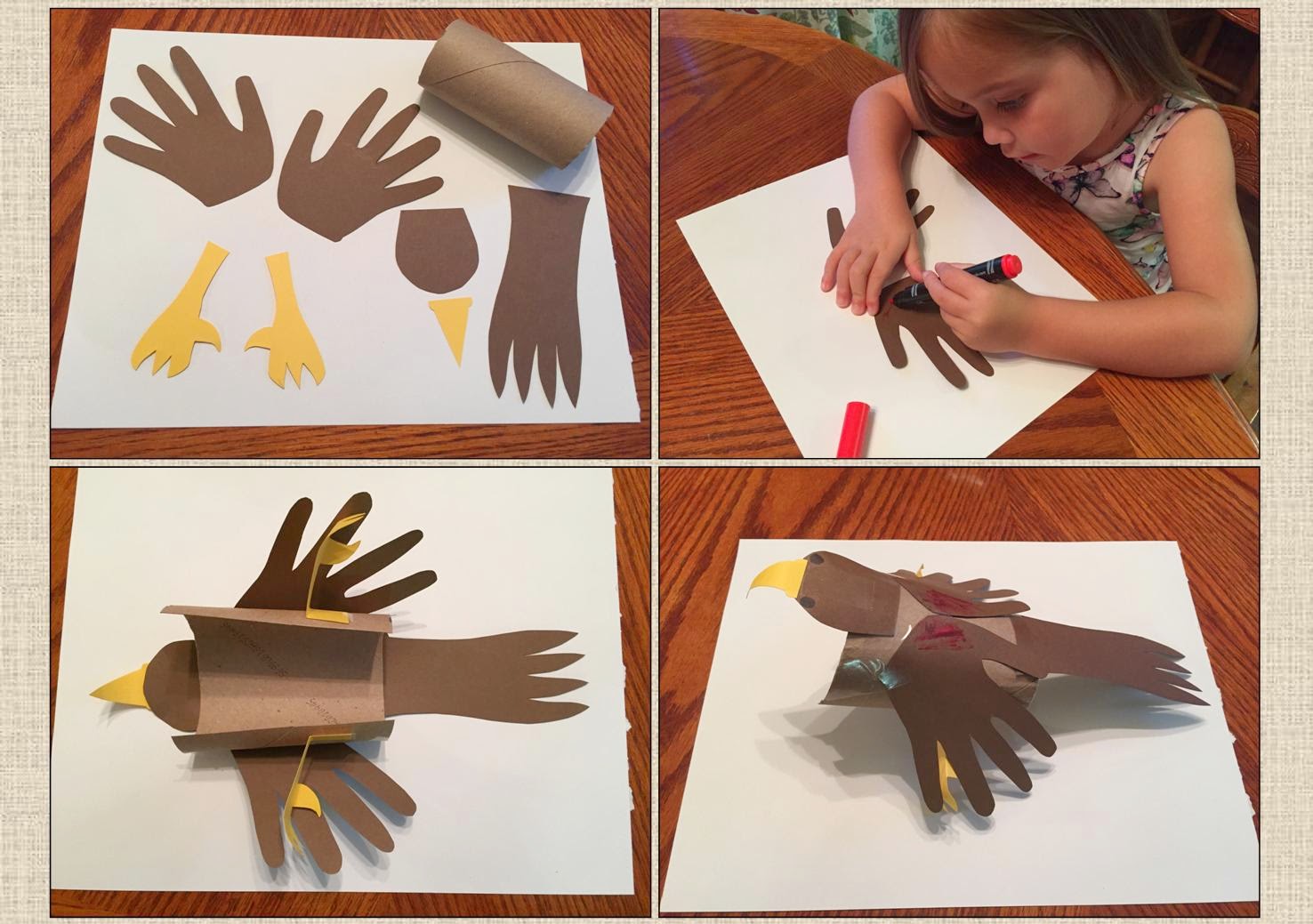
Red-Shouldered Hawk Craft
To celebrate the exciting return to the nest, my daughter and I made a hawk out of construction paper and the cardboard from a roll of toilet paper (you can also use paper towel roll cut to the size of a toilet paper roll).  I traced my daughter’s hand on two pieces of brown construction paper and cut them out to make the wings.  Next I cut out a tail and head from the brown construction paper and talons/legs and a beak from yellow construction paper.  My daughter used a red marker to add a little coloring to the shoulder of each wing.  I helped her tape (you can use glue if you’re not in a hurry) each body part to the paper roll in the correct place.  Then I cut a straight line down the middle of the paper roll (the belly of the bird), running between the legs.  This allowed my daughter to wear the bird on her arm while she played and “flew” with it around the yard.  It’s easy and makes a fun toy.  Just remember, it doesn’t have to be perfect because it’s a craft for children to play with and enjoy.  Plus, you can always make another one later!
Flying Hawk Craft

Happy Mother’s Day!


* I know both hawk parents helped to insure their juvenile’s survival; and likewise, many moms rely on dads to help care for and protect their children.  Dads are great too.  But this is Mother’s Day, and today we are celebrating Moms!

Tuesday, April 28, 2015

It's a Ladybug's Life!


Letting Our Ladybugs be Free
My daughter was so excited to get an Insect Lore Ladybug Land habitat from one of her friends for her birthday.  At first, she wasn’t sure what to do with it since the live insects needed to be ordered and sent to our home via snail mail.  So she played with the enclosure for a few days, finding her smallest toys, which just fit in it.  I let her know what day the bugs would be arriving and explained to her that they would not look like ladybugs yet, but were larvae.  Fortunately, since she recently had a lesson on butterfly lifecycles at her preschool, the larval stage was fresh in her memory.

Nineteen little bugs arrived in a tube on a Friday.  My daughter anxiously watched as I slid the little creatures and their food into their new home and gave them a couple droplets of water.  But to my daughter, the larvae were so small and strange-looking, her attention started to waver.  I quickly found videos of ladybugs on the internet to keep her excitement high for these new bugs.  Luckily, by the next day, the larvae were nearly twice as big, very active, and much more visible.  The change was perfect to keep her interest high.  These bugs ate and ate and grew bigger and bigger each day.  My daughter even asked us to buy a magnifying glass to help her see them better.  
 
Because it was very important not to over water the little bugs, I took charge of giving them water using the pipette provided with the habitat.  My three year old doesn’t quite have the fine motor skills required to gently squeeze the bulb of the pipette to consistently produce only one droplet of water at a time yet.  So after my watering chore each day, she practiced using the pipette herself, which is an excellent activity for kids her age.
Larva, Pupa, and Adult Stages
On day five, the first larva turned into a pupa.  By the end of the next day, they had all changed, and then there was no movement in the habitat for days.  Fortunately, the instructions gave us an estimate of when to expect the adults to emerge; therefore, we knew we didn’t have long to wait.  We were prepared with a rehydrated raisin cut in half for their food.  And four days later, our first adult ladybug emerged!  The rest followed over the next two days.  I was lucky enough to watch and record one emerging using time-lapse videography while my daughter napped.  This allowed me to show her later what was happening without her shorter attention span preventing her from watching in real time.  She was amazed and watched the video over and over again!

Mating Behavior
When a ladybug emerges from the pupa stage, it climbs out of the bottom of the hard exoskeleton, leaving it behind.  The newly emerged adult is soft and off-white in color without spots.  It rests and dries its body for awhile, stretching its wings and legs only occasionally while slowly gaining its familiar ladybug coloring.  During the first day, it doesn’t really move much.  Then on day two as an adult, it moves everywhere, taking short breaks to eat and drink.  We even witnessed mating behavior!  Our ladybugs seemed to only calm down when the lights were off.  It was fun watching them travel during the day, but it made them difficult to count while my daughter eagerly watched.  I’m happy to report, while they were at rest, I counted and all nineteen insects made it to the adult stage.

Last Saturday, we turned them loose.  It was nice to watch all of the ladybugs crawl away.  A few even attempted to fly away.  My daughter was a little sad and questioned several times why we needed to set them free, but she enjoyed watching the bugs crawl over the plants and in the leaf litter.  She agreed that it will be nice to have them living in our yard; although, she thinks we’ll be able to find them again easily.  Luckily, the ladybug habitat is able to be used again and again for raising more ladybugs!
Making a Ladybug Keepsake
Since this project took two weeks, I decided we needed to make a keepsake of our experience.  So I bought a small canvas and acrylic paint to make a handprint bush with 19 ladybugs made from fingerprints.  I painted the canvas blue the day before and let it dry overnight.  The next day, I painted my daughter’s hand a dark green color and let her put her handprint on the canvas, with my help, and we let it dry.  For the next step, I painted her other hand a light green color and again helped her to put her handprint on the canvas on top of the first handprint.  The handprints made the bush.  After the bush was completely dry, I painted her index finger red, and she proceeded to make 19 fingerprints on the bush, one for each ladybug we raised.  After that was dry, I took a black paint pen and completed the look of each ladybug.  It turned out to be a beautiful keepsake of our first experience with ladybugs that we will never forget!
Ladybug Keepsake